
The Currents of Kate’s Conservation: A Call for Ocean Optimism
An interview with alumna Kate Weston-McDowell conducted by Global PR student Lara Jones
20 January 2026
From her first internship in Cape Verde to managing global conservation teams, 2015 graduate Kate Weston McDowell has created her own path, advocating for accessibility and equal opportunity.
I exited our conversation with a core understanding of what drives her; the ocean is ours to protect and ours to admire.
Early Connection to the Ocean
Kate is perched atop the sea wall, monitoring bottlenose dolphins in Cardigan Bay, West Wales, for an internship the year following her graduation. “I had this full circle moment where I was like, oh my god, I’m going to talk to kids who are like me,” Kate says. “I was obsessed with the dolphin people, and now I’m a dolphin person!” she laughs.
Though she now lives in Portsmouth, her Welsh upbringing lingers in everything she does. As a young girl, she would watch people on the sea wall and obsess over the dolphins. She describes her interest in the sea as a ‘typical childhood obsession’ she never grew out of.
"You’re going to be a Marine Biologist,” her dad told her. She didn’t know what that meant at the time, only that it sounded cool. This is what she thinks of as she enters adulthood, sat on the same wall she watched people on as a child.
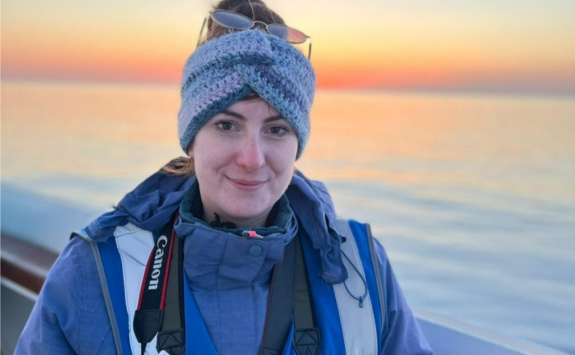
"Even though I live in England now, I’m still a proud Welsh woman, so being able to contribute to conservation in my home country was amazing.” This internship, and other early experiences would eventually lead her to her role today – International Ocean Conservationist Manager at ORCA.
Thrown into the Deep End
Before her time in Cardigan Bay, Kate set sail for Newcastle University. Her degree offered hands-on opportunities that helped her to feel less intimated by future internships, and the city’s friendly charm reminded her of her home city, Cardiff. We bonded over our preference for smaller cities that are bustling, but still maintain a cosy, communal feel.
“I’ve always felt at home there,” she says. She would have stayed, but other opportunities awaited elsewhere. Luckily, she has a friend who still lives in
Newcastle, so she visits often.
Transitioning from small high school in Wales to a large university was daunting, but the university cushioned her fears and gave her a safe space to grow. The distance from home encouraged her to persevere through self-doubt, and make the most of her surroundings. “A city far enough away from where I grew up so that I couldn’t pop in whenever I wanted, but it felt like home.”
Kate emphasises that she has never been a believer in fate. At university, she actively sought opportunities – academically and socially. Her extra-curriculars in Wind Band and Orchestra provided a community outside of her course and flat. She has had valuable experiences, made lifelong friends, and lifelong memories.
Operation Wallcea
For her dissertation, Kate partnered with Operation Wallcea, a charity funding research for dissertations globally. Interested in the interaction between human and wildlife, she went to Akumal, Mexico to study the disturbance of human life to nesting turtles. “I do think that watching wildlife is one of the best ways to spread the message about conservation.”
Even though her focus later shifted towards cetaceans, she treasures the experience. “Mexico will always be close to my heart because it was the first time I saw a turtle. Holding a baby turtle for the first time was incredible.”
Unequal opportunities & Kate’s Resistance
Insistent in taking every opportunity, Kate refused to let her financial situation limit her. Marine conservation can be inaccessible to students from different economic, ethnic, or neurodivergent backgrounds. Like many students, Kate did not have the money, nor the cultural capital to harness her.
“My parents are not academics in any way, so I didn’t have that grounding.”
She encourages students from disadvantaged backgrounds to not overlook volunteer opportunities that don’t require payment – like the ones she did after graduation. She worked as a waitress between internships to fund travel costs.
She also feels that students shouldn’t underestimate the opportunities in the UK. “As an island we have so much diversity.” This expansive, vibrant sea life is just as worth exploring as other parts of the world.
Combatting the accessibility issue today: Kate’s contribution
Part of Kate’s job at ORCA as an EDI champion is focussing on inclusive recruitment. She trains hiring managers in bias reduction and considers all
applicants. “The people who stand out are the people who can tell me why they’ve done things,” she says. “Saying, I took a retail job to fund myself in conservation or learn people skills,” speaks more to her than a gap year abroad with little context.
Kate’s favourite part about her job is the people. She loves giving opportunities to those who might have never had them. “I get to call people and be like ‘Hey! Do you want to go to Antarctica?’ There aren’t many jobs where you get to do stuff like that,” she says. She looks forward to their return stories – the experiences, the people they meet. She ensures everyone has a chance to contribute to research.
On Ocean Optimism
Kate’s relationship with the ocean and marine life hasn’t changed since being a young girl at Cardigan Bay. She remains optimistic about the ocean’s future. “You can’t look at everything as doom and gloom, or expect everyone to change overnight, you have to see the positives and move forward.”
She is optimistic, but not unrealistic. “What we need is a world full of imperfect people trying their best,” she says. This mindset applies both to conservation and giving people equal opportunities. Conservation is a rewarding field, and Kate takes pride in dedicating herself to it. “I don’t think you have to be a scientist to feel a connection with the water. That’s something I have always felt and will continue to feel."