Architecture, Master of (MArch)
- Study mode and duration
- Course code
- 5843F
- Fees (per year)
- Typical entry requirements
-
View full entry requirements - Course delivery
- On Campus
Course information for entry year:
Overview
Why study at Newcastle?
- Work in research-led vertical design studios, offering you space and freedom to explore your own ideas.
- Take advantage of a range of opportunities to study abroad.
- Study in a vibrant and popular student city with a rich architectural history, and a range of live architectural projects on your doorstep - from urban regeneration to creative communities and innovation neighbourhoods.
Driven by your own critical thinking and creative agendas, our multi-disciplinary academic and practitioner teaching team will support you through hands-on design research projects, to explore your own ideas and define your own future.
You’ll tackle meaningful societal challenges and encounter innovative design methods through a choice of design studios. Our culture is one of enquiry, creativity, and collaboration.
Your project work will be complemented by lectures and seminars, to examine the theoretical, practical and material dimensions of architecture.
The programme will open your ways of thinking about architectural design and broaden your perspective on how practice will develop in the future.
You will graduate with strong critical thinking, confident communication, and robust practical skills. These strengths will give you a solid foundation for your future, whether in professional practice or further study.
Connected expertise
Our range of studios will offer you connections with the latest research into living materials and regenerative design through the Hub for Biotechnology in the Built Environment. As an MArch student at Newcastle you will benefit from both the academic and technical teams associated with the hub, which brings together bio-scientists, architects, designers and engineers.
Read about the hub’s work on mycelium and the future of sustainable design.
Offering you the opportunity to play a part in widening debate and engaging communities in architecture and planning, our pioneering Farrell Centre is an ‘urban room’ in the centre of Newcastle.
The driving force behind the centre’s creation and opening in 2023 was Newcastle alumnus Sir Terry Farrell. As well as being open to the public, the centre supports key links with our research. It is becoming a hub for the architectural professional, and the young practitioners’ community locally.
Highlights of our students’ work
Our School Gallery has examples of our student's work and images from our Degree Shows and publications.
Success in national awards: RIBA President’s Medals
- Maria Wood, 2024 Part 2 Commendation
- Chloe Dalby, 2023, Part 2 Serjeant Award for Excellence in Drawing
- Nicholas Honey and Robert Thackeray, 2022, Part 2 Award for Sustainable Design
Important information
We've highlighted important information about your course. Please take note of any deadlines.
Please rest assured we make all reasonable efforts to provide you with the programmes, services and facilities described. However, it may be necessary to make changes due to significant disruption, for example in response to Covid-19.
View our Academic experience page, which gives information about your Newcastle University study experience for the academic year 2025-26.
See our terms and conditions and student complaints information, which gives details of circumstances that may lead to changes to programmes, modules or University services.
Quality and ranking
All professional accreditations are reviewed regularly by their professional body
If you’re studying an accredited degree and thinking about working in Europe after you graduate, the best place to find current information is the UK Government’s guidance on recognition of UK professional qualifications in EU member states. This official resource explains whether your profession is regulated in another country, what steps you need to take, and which organisation you should contact.
What you'll learn
Our two-year research-led programme empowers you to ask meaningful questions, to explore real-world challenges and to practice socially engaged design. The course encourages diversity of technique, and exploration. Your perspective, developed through focused project work, will be powerful and distinctive.
Project themes are closely connected to the United Nations Sustainable Development Goals (UNSDGs). These range from social and environmental justice to the impact of political crisis and altering historical perspectives.
Our vertical design studios will enable you to explore important issues with an innovative approach. You might study the legacies of modernist architecture, regenerative construction and developing the bio-materials of the future, the impact of design on health, wellbeing and recovery, or something else entirely. Wherever your interests lie, you'll tackle real-world issues with creativity and purpose.
As your own critical thought and creative application develops, you will take the principles of research-led design and refined practical skills forward into your own future.
Programme organisation
The programme is organised around research-lead design studios, which account for two thirds of the credits in each semester.
We work in 'vertical studios'. Students and tutors co-develop the direction of the studios. These shared spaces encourage an open culture, collaboration, and a strong feeling of community between tutors and students from both stages.
Our studios all have critical questions at their centre, rather than focusing on a style or aesthetic. This encourages creative ways of thinking about the questions that matter.
- In stage 5, semester 1 focuses on strategic scale, engaging with social, cultural, economic and environmental contexts. This includes a field trip to a city in the UK.
- Semester 2 focuses on the building scale, and addresses issues of material, construction, performance and technical competency.
- In stage 6 you'll develop an independent thesis inquiry. This is supported by the structure and themes of the vertical studio.
Modules
You will study modules on this course. A module is a unit of a course with its own approved aims and outcomes and assessment methods.
The module information below is intended to provide an example of what you will study.
Our teaching is informed by research. Course content changes periodically to reflect developments in the discipline, the requirements of external bodies and partners, and student feedback.
Full details of the modules on offer will be published through the Programme Regulations and Specifications ahead of each academic year. This usually happens in May.
To find out more please see our terms and conditions.
Optional modules availability
Some courses have optional modules. Student demand for optional modules may affect availability.
- Architectural Design Research 1 (Semester 1)
- Tools for Thinking About Architecture (Semester 1)
All students will also take the following module, except for those taking part in a single semester exchange programme in Stage 5 semester 2:
- Architectural Design Practice 1 (Semester 2)
Students on a Stage 5 semester 2 exchange route will take instead the following module to cover all credits for the semester spent abroad:
- Exchange Study Project (Semester 2)
Our optional modules are organised into themed groups which allow you to:
- develop a specialism
- pursue accelerated routes towards MA or MSc degrees
- go on exchange
Group A
Group A optional modules form the primary route to MArch.
Group B
Group B modules are for students wishing to pursue a specialism in Urban Design.
Group C
Group C modules are for students wishing to pursue a specialism in Urban Planning.
Group D
Group D modules are for students wishing to go on exchange in semester 2 of Stage 5
- Architectural Design (Semester 1 and 2)
- Architectural Practice (Semester 2)
Our optional modules are organised into themed groups which allow you to:
- develop a specialism
- pursue accelerated routes towards MA and MSc Degrees
- go on exchange
Group A
Group A optional modules form the primary route to MArch.
Group B
Group B modules are for students wishing to pursue a specialism in Urban Design.
Group C
Group C modules are for students wishing to pursue a specialism in Urban Planning.
How you'll learn
You will follow a modular structure based on project work, with a range of studio options. This offers the opportunity to specialise through the choices that you make during your study.
Projects are independent but scaffolded, following broad themes within each vertical studio. These are selected by students at the start of the year.
You will be supported to pursue your own areas of critical interest by our specialist academic and practitioner staff members, with exceptional personalised tuition and group tutorials as a key point of contact. There is the opportunity to collaborate in your project if you wish.
Depending on your interests, you will have the opportunity to work on-site with live build projects. These unique projects enable you to operate like a practice with local clients and communities, creating small structures and installations in a practical execution of your ideas and vision.
Your project work will be accompanied by lectures and seminars examining the theoretical, practical and material dimensions of architecture.
We emphasise space for discussion throughout the programme. Encouraging confidence in articulating your ideas is key as you develop your own abilities and your own distinctive portfolio.
Depending on your modules, you'll be assessed through a combination of:
- Dissertation
- Essay
- Oral presentation
- Portfolio
- Report
- Reflective log
- Research proposal
Throughout your studies, you’ll have access to support from:
- academic staff
- personal tutors and research supervisors
- our University Student Services Team
- student representatives
- peers
You'll also be assigned an academic member of staff, who will be your personal tutor throughout your time with us. They can help with academic and personal issues.
Your teaching and learning is also supported by Canvas. Canvas is a Virtual Learning Environment. You'll use Canvas to submit your assignments and access your:
- module handbooks
- course materials
- groups
- course announcements and notifications
- written feedback
Your development
Critical thought and creative practice
Our academic staff will encourage you in developing your own ideas to guide your career. In asking what sort of architect you want to be, we focus on the future of the profession that you will help to shape. We encourage challenges to existing conventions and foster ambitious and innovative thinking, setting you up to be future leaders.
Study abroad opportunities
You will have the opportunity to study abroad for semester 2 of your first year. Or, take a whole year to study abroad between your first and second years of the programme in Newcastle.
This highly sought-after part of our programme brings a breadth of perspective, enabling you to work with a wider appreciation of new contexts and applications.
Locations for study abroad opportunities range across Europe, East Asia and Australia. Our exchange partners include The University of Sydney, KTH Stockholm and The National University of Singapore.
Entry requirements
The entrance requirements below apply to 2026 entry.
Qualifications from outside the UK
English Language requirements
Admissions policy
This policy applies to all undergraduate and postgraduate admissions at Newcastle University. It is intended to provide information about our admissions policies and procedures to applicants and potential applicants, to their advisors and family members, and to staff of the University.
University Admissions Policy and related policies and procedures
Credit transfer and Recognition of Prior Learning
Recognition of Prior Learning (RPL) can allow you to convert existing relevant university-level knowledge, skills and experience into credits towards a qualification. Find out more about the RPL policy which may apply to this course
Pre-Master’s and English Language courses
Need an alternative route to study this course? Our International Study Centre offers Pre-Master’s degrees and English language courses to prepare you for study.
Your future
Whether you wish to enter architectural practice or pursue your own academic or creative career, our multi-disciplinary teaching team will equip you with the skills that you need for success.
The programme offers good connections with practices around Newcastle. Our staff includes award-winning, practicing architects, bringing the world of work and your future career directly into our studios.
As well as creating a social focus and supporting broader wellbeing, our active student society runs regular talks and events with local and nationally recognised practitioners too.
As a graduate of our MArch course, you will be joining a high-achieving body of alumni.
Recent graduates include:
- James Longfield – BA, MArch and PhD graduate, Director Northern Bureau for Architecture, included in the Architecture Foundation’s New Architects Five
- Katie Fisher – graduate of BA and MArch, RIBAJ Rising Star 2024
- Michelle Martin – graduate of MArch, RIBAJ Rising Star 2022
- Alasdair Ben Dixon – BA and BArch (earlier version of MArch) graduate, co-founder of innovative practice Collective Works, co-author RIBA Ethical Practice Guide
- Mawson Kerr, award-winning North East practice founded by two Newcastle alumni
Employability
Students from Newcastle’s Architecture MArch course are highly sought after due to their distinctive skills, independent thinking, and design agility.
Our graduates have gone on to work at a wide range of globally influential architectural firms, as well as emerging firms with strong reputations in design innovation, sustainability and socially engaged practice which are leading change in the profession.
These include Weston Williamson + Partners, MAKE Architecture, dRMM Architects, Lifschutz Davidson Sandilands (LDS), Levitt Bernstein Architects, Cartwright Pickard, and Studio Egret Design.
Students who have recently completed their study at Newcastle have gone onto roles including Architect, Architectural Designer, Design Consultant, Estate Planning Assistant, Workplace Designer, and Workplace Design Manager. Some of our graduates choose to progress into further academic study in architecture or related fields.
97% of Newcastle’s Architecture MArch graduates were in work or further study 15 months after graduation (Graduate Outcomes Survey data 2017-2023)
Our Careers Service
Our expert Careers Service is here to help you take the next steps in your professional life. We will support you while you’re studying with us and for up to three years after you graduate.
You will have access to expert one-to-one advice and guidance through our campus careers centre and online, along with digital resources, workshops, networking opportunities, and careers and recruitment events.
We’ve been awarded 5 QS Stars for Student Employability (2025). Many of our degrees are shaped by strong links with national and international businesses. We are committed to helping you access real-world experience opportunities and develop key skills through paid work placements and internships.
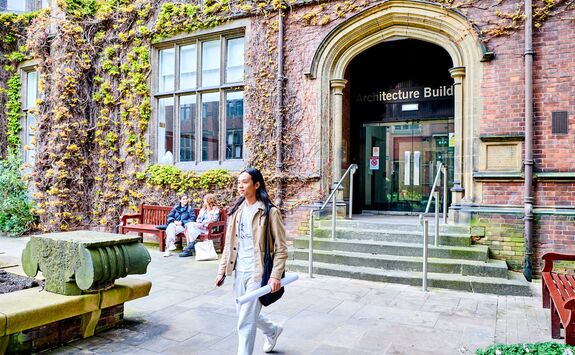
Facilities
Whether you’re interested in developing innovative materials and constructions, experimenting with digital design and fabrication, or crafting speculative models and drawing, our exemplary workshops and studio facilities will enable you to explore your own ideas and develop distinctive techniques.
These spacious and well-equipped creative spaces are supported by dedicated technicians. They are solely the resource of our architecture, planning and landscape students, giving you space and freedom to explore that won’t be found elsewhere. They include some of the latest digital and biological manufacturing tools.
Facilities available include:
- lively design studios, equipped with computer workstations and drawing boards
- flexible exhibition and review spaces
- well-equipped workshop, with tools for working with timber, plastics, metal, ceramics and textiles, and including the latest digital manufacturing technology
- wet fabrication lab including 3D printers
- molecular biology lab (one of the first in the world to be administered by a school of architecture), for working with biomaterials
- printing suite with large format printers and scanners
- digital studios equipped with powerful computers and the latest design software
Our lively design studio culture will make your study a creative and collaborative experience. With extended access to our studios, we encourage flexible working to fit in with your own lifestyle and commitments.
Fees, Funding and Scholarships
Tuition fees for 2026 entry (per year)
Tuition fees are payable for each year of your course. £9,535 is the maximum fee that we are permitted to charge for home fee-paying students for the academic year 2025-26. This is set by the UK government. This fee has not yet been confirmed for 2026-27.
As a general principle, you should expect the tuition fee to increase in each subsequent academic year of your course, subject to government regulations on fee increases and in line with inflation.
Home students commencing professional studies on an ARB/RIBA accredited Part I course in the UK prior to 2012
If you began your professional studies on an ARB/RIBA accredited Part I course in the UK prior to 2012 you will remain eligible for tuition fees at the old, lower rate of £3,465. To be eligible for the lower rate the gap between taking Part I and Part II must not exceed three years. This applies whether you are a Newcastle graduate or an applicant from another UK institution. Contact the School if you have any questions about fees.
As a general principle, you should expect the tuition fee to increase in each subsequent academic year of your course, subject to government regulations on fee increases and in line with inflation.
Depending on your residency history, if you’re a student from the EU, other EEA or a Swiss national, with settled or pre-settled status under the EU Settlement Scheme, you’ll normally pay the ‘Home’ tuition fee rate and may be eligible for Student Finance England support.
EU students without settled or pre-settled status will normally be charged fees at the ‘International’ rate and will not be eligible for Student Finance England support. You may be eligible for a scholarship worth 25% off the international fee. Search our funding database.
If you are unsure of your fee status, check out the latest guidance here.
Scholarships
We support our EU and international students by providing a generous range of Vice-Chancellor's automatic and merit-based scholarships. See our searchable postgraduate funding page for more information.
What you're paying for
Tuition fees include the costs of:
- matriculation
- registration
- tuition (or supervision)
- library access
- examination
- re-examination
- graduation
Find out more about:
If you are an international student or a student from the EU, EEA or Switzerland and you need a visa to study in the UK, you may have to pay a deposit.
You can check this in the How to apply section.
If you're applying for funding, always check the funding application deadline. This deadline may be earlier than the application deadline for your course.
For some funding schemes, you need to have received an offer of a place on a course before you can apply for the funding.
Search for funding and scholarships
Find funding available for your course
How to apply
Using the application portal
The application portal has instructions to guide you through your application. It will tell you what documents you need and how to upload them.
You can choose to start your application, save your details and come back to complete it later.
If you’re ready, you can select Apply Online and you’ll be taken directly to the application portal.
Alternatively you can find out more about applying on our applications and offers pages.
Apply Online
Open days and events
Find out about how you can visit Newcastle in person and virtually
Overseas events
We regularly travel overseas to meet with students interested in studying at Newcastle University.
Get in touch
Questions about this course?
If you have specific questions about this course you can contact:
Jack Blenkinsopp
Learning and Teaching Assistant
School of Architecture, Planning and Landscape
Telephone: +44 (0) 191 208 4881
Email: jack.blenkinsopp@newcastle.ac.uk
General enquiries
For more general enquiries, you could also complete our online enquiry form.
Application enquiries
If you've got a question about your application, send us an enquiry via the application portal you applied through.
If you haven't applied yet, you can send your questions via our enquiry form.
Live chat
Our Ncl chatbot might be able to give you an answer straight away. If not, it’ll direct you to someone who can help.
You'll find our Ncl chatbot in the bottom right of this page.
Keep updated
We regularly send email updates and extra information about the University.
Receive regular updates by email
Social media
Get involved with the School of Architecture, Planning and Landscape.